

Unlock Your Potential with a Growth Mindset Worksheet

Table of Contents
A Growth Mindset Worksheet can be a Practical Tool for Developing a Positive Mindset
Have you ever felt stuck in your personal or professional life? It’s easy to get caught up in negative self-talk and believe that our abilities are fixed. However, having a growth mindset can help us overcome obstacles to achieve our goals. In this article, we’ll explore how you can develop a growth mindset for yourself.
Understanding What a Growth Mindset Is
Carol Dweck’s research on growth mindset has been a game-changer for millions of people around the world. A growth mindset is a belief that our qualities and abilities can be cultivated through effort and perseverance. This idea contrasts with a fixed mindset, which suggests that our traits are predetermined and unchangeable.
Developing a growth mindset takes time and effort, but it’s worth it. By embracing challenges, learning from failure, practicing self-reflection, surrounding yourself with positive influences, and celebrating progress, you can develop a growth mindset and achieve your goals.
Ready to jumpstart your growth and find ways to become a better version of yourself? You are in luck! With just a little intentional focus and practice, these five habits can help you become a better you and allow you to achieve your goals.
#1. Write in a Journal Every Day
Journaling is an excellent habit that can promote personal development and a growth mindset. When you regularly write in a journal, you practice self-reflection and evaluation, which enables you to identify what is working in your life as well as where there is room for improvement.
Daily journaling is an opportunity to process emotions, find patterns of thought and action that are contributing to your struggles and find solutions to problems that are continually popping up in your life. A habit of daily journaling can improve your self-awareness and enhance your growth-oriented thinking.
#2. Foster Healthy Relationships
When you learn to value your personal growth and development, you are more likely to honor the healthy relationships in your life, seek out others with a similar mindset, and finally remove the toxic people in your life that have been holding you back. Looking after your strong and helpful bonds can keep you focused on improving yourself. Your relationships will support you during tough times, too. Concentrating on building healthy connections and cutting out those that drag you down will be necessary for fostering your growth mindset.
#3. Stretch Your Comfort Zone
In the comfort zone, no learning occurs. In order for you to grow, you need to experience some disequilibrium in your life. Things have to be just out of reach, just beyond your current level of capabilities for learning to take place. This zone, where things are a little bit too hard but not exceptionally so, is where your comfort zone ends. It is sometimes called the zone of proximal development, which really just means it is where learning begins. Extending your comfort zone in small ways every day can help you learn, contribute to your personal growth, and cultivate your growth mindset.
Try new things, they only need to be small steps, to begin with, like taking a new route to work without using a map or talking to a stranger. Any little thing you can do to extend that comfort zone is going to help you become a lifelong learner.
#4. Give Back to Others
When you extend yourself to other people, you can improve your growth mindset in several vital ways. The first is that volunteering, helping others, or giving back to your community offers a way for you to share your gifts and expertise with others. This improves your own capabilities and helps you feel more confident.
Helping others also exposes you to new viewpoints, ideas, beliefs, and values. The more you learn about how other people live, what they need, and how they think, the more possibilities you open for your own learning and growth. Giving back to others in need or teaching others about things you know is a perfect way to enhance your growth mindset while also improving someone else’s life at the same time.
#5. Use a Growth Mindset Worksheet
To start your growth mindset journey, using a growth mindset worksheet can be a great way to keep track of your progress and stay motivated. A growth mindset worksheet is designed to help you reflect on your strengths and weaknesses and set goals for improvement. It can also help you identify areas where you need to focus more effort in order to develop a growth mindset. There are many different growth mind worksheets available online that you can use to get started.
Growth mindset worksheets are a great starting point to help us develop this way of thinking by providing exercises and prompts that encourage positive self-talk, goal-setting, and resilience. One of the most interesting aspects of growth mindset worksheets is that they often feature quotes and examples from famous people. These individuals have achieved great things in their lives by adopting a growth mindset approach. For instance, Thomas Edison failed many times when inventing the light bulb before finally succeeding. His famous quote “I have not failed. I’ve just found 10,000 ways that won’t work” shows his determination to keep trying until he succeeded.
So why use a growth mindset worksheet? For starters, it helps us shift our focus from fixed limitations to possibilities for growth. Through intentional reflection on personal strengths and weaknesses, we can identify areas for improvement and set achievable goals. This process fosters a sense of agency and empowers us to take control of our own learning and development journey.
Moreover, using a growth mindset worksheet can also increase motivation levels by fostering an optimistic outlook toward challenges. It encourages us to see obstacles as opportunities for learning rather than setbacks. A growth mindset worksheet can be a powerful tool for professional development. By focusing on the concept of a growth mindset, we can learn to cultivate a positive attitude toward learning and growth, which can help us achieve our goals and reach our full potential.
The worksheet is a simple yet effective tool that offers practical strategies for changing negative beliefs and thought patterns into positive ones. It can be used by anyone who wants to improve their mental resilience, boost their motivation, overcome challenges, and achieve their goals.
The purpose of a growth mindset worksheet is to help us understand the difference between a fixed mindset and a growth mindset. A fixed mindset assumes that our abilities are predetermined and unchangeable whereas a growth mindset believes that we can cultivate our abilities through dedication, hard work, and persistence. By using the worksheet, we can identify our limiting beliefs, reframe them in a positive light, set achievable goals, create action plans for achieving them and track their progress along the way.
The worksheet consists of various exercises, such as writing down your goals, tracking your progress, and reflecting on your achievements.
One key aspect of the growth mindset worksheet is the use of mindset statements. These statements are affirmations that promote a growth mindset culture that helps you reframe negative self-talk into positive self-talk. For instance, instead of saying “I am not good enough,” a mindset statement could be “I am capable of achieving my goals with effort and practice.” By repeating these affirmations regularly, you gradually train your mind to focus on the possibilities rather than limitations.
Another benefit of using a growth mindset worksheet is that it helps you identify areas where you need improvement. They can be used by elementary students, high school students as well as older students, employees, entrepreneurs, or anyone who wants an excellent way to take charge of their own growth.
The best part about these worksheets is that there are many free resources available online that you can use right away. Whether you’re looking for a growth mindset definition or exercises to boost your creativity or strategies for overcoming self-doubt, there’s something out there for everyone. You can find worksheets, growth mindset lessons, growth mindset posters, and lesson plans with lots of fun activities on topics like goal-setting, self-reflection, problem-solving, and more.
Using a growth mindset worksheet regularly can have a profound impact on your life.
A growth mindset worksheet is an excellent tool for anyone looking to cultivate a new skill and a positive attitude toward learning and growth. This type of worksheet offers fun activities that can help you develop a growth mindset, which is the belief that your abilities can be developed through dedication and hard work. By completing these activities, you will learn how to embrace challenges, persist in the face of setbacks, and see effort as a path to mastery.
One example of a fun activity on a growth mindset worksheet is creating a vision board. This involves choosing images and words that represent the goals you want to achieve and pasting them onto a sheet of paper or poster board. By visualizing your goals in this way, you’ll be more motivated to pursue them with enthusiasm and positivity. Another activity could be writing down your negative self-talk on one side of the paper and then reframing those thoughts into positive ones on the other side.
How to Use a Growth Mindset Worksheet
Using a growth mindset worksheet is simple. Here are some steps to create your own growth mindset worksheet:
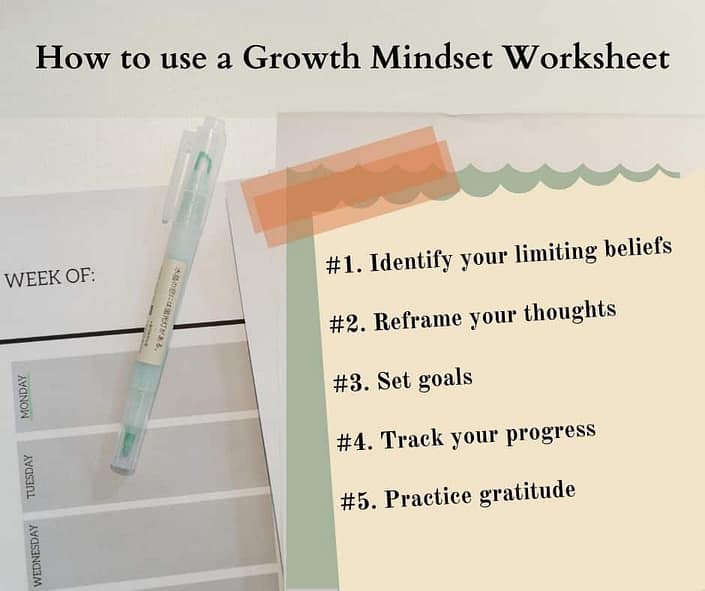
1. Identify your limiting beliefs
What beliefs or thoughts are holding you back from achieving your goals? Write them down and challenge them. Ask yourself, “Is this belief true? Is it helpful? What evidence do I have to support or refute this belief?”
2. Reframe your thoughts
Once you’ve identified your limiting beliefs, reframe them into more empowering thoughts. For example, instead of “I’m not good at public speaking,” reframe it as “I’m still learning how to be a better public speaker.”
3. Set goals
Write down your short-term and long-term goals. Make them specific, measurable, and achievable. Break them down into smaller, manageable steps.
4. Track your progress
Track your progress towards your goals. Celebrate your successes and learn from your setbacks. Use this information to adjust your approach and keep moving forward.
5. Practice gratitude
Gratitude is an important aspect of developing a growth mindset. Write down three things you’re grateful for each day. This can help you focus on the positive aspects of your life and cultivate a more optimistic outlook.
By using a growth mindset worksheet, you can develop a more positive and productive mindset. Remember, growth is a process, and setbacks are opportunities to learn and grow. With practice and persistence, you can achieve your goals and reach your full potential.
Here are some examples of prompts that you might find on a growth mindset worksheet:
- What are some challenges you have faced in the past? How did you respond to these challenges?
- Do you believe that your abilities can change and grow over time? Why or why not?
- What are some limiting beliefs that you hold about yourself? How can you challenge these beliefs?
- What are some areas where you would like to improve? How can you use a growth mindset to achieve your goals?
- What are some strategies that can help you overcome obstacles and setbacks?
Be aware of your Language
- Instead of I can’t / I don’t know how to do this, Say I will learn how to do this.
- Instead of I am not good at X, Say I am not as good at X as I want YET, but I am in the process.
- Instead of I can’t make mistakes, Say I am aiming for progress not perfection.
- Instead of Everyone is so far ahead, Say I am proud of where I am in the journey and inspired by the people who are further than me.
Growth Mindset Affirmations
By having these positive affirmations close at hand will put you in the right mindset to help ingrain new beliefs and overcome old negative thoughts.
- I am on the right track
- This might take time and effort
- I ask for help when I need it
- I strive for progress, not perfection
- I cheer myself up when it gets hard
- There are no limits to what I can do
- I can overcome challenges
- Since I work hard, I will succeed
How to Help Your Child Develop a Growth Mindset
Learning to embrace a growth mindset when you are young is the perfect time to adopt this positive attitude. Children who are growth-oriented are more likely to enjoy school, to achieve their goals, and to have higher self-esteem. Teachers and parents who are looking for ways to cultivate a growth mindset in their children can follow these guidelines and advice to help their kids value learning and embrace the power of growth.
Tips for Cultivating a Growth Mindset in Children
#1. Make sure they know it is okay if they fail. When you give your child permission to try, even when it could result in the wrong answer or a failed attempt, they expand their learning and become more comfortable with taking risks. They pick up on their values from you, so be sure you share how you deal with failure and what you learn from your mistakes, as well.
#2. Integrate “yet” into your vocabulary. When your child talks about something they can’t do, remind them that this is merely something they have not learned yet. When they are focused on a mistake, help them see that the solution just has not been discovered yet. The word “yet” opens possibilities for the future and keeps them focused on what is still to come.
#3. Give your kids chores and tasks. When your child accomplishes something, they will feel pride in their work, which builds confidence. The earlier children have responsibilities, the more they become involved in family life and the needs of your household. Allow kids to accomplish tasks in their own way, so that they can learn from their mistakes, too.
#4. Use praise strategically. When you are complimenting your child, make sure they know what it is that you are placing value on. Instead of saying, “good job,” maybe try praising them for trying several ways to solve a problem. Instead of telling them they are smart, tell them they are strong or resilient.
#5. Talk about how brains get stronger over time. Kids need to know that their minds are just like other muscles in their bodies, and they can improve and get stronger when they use them in new ways. Using the language of growth thinking, including those of continuous or life-long learning, is crucial when talking to your children.
#6. Reward effort as well as results. The final grade is the result of all the hard work throughout the semester, so be sure your kids know that those efforts are essential all along the way. And hard-fought outcomes, even when they are not what was expected, are more important than easily achieved goals.
#7. Be a growth mindset role model for your children. When they look at you, they need to know that you value learning and mistakes in the same way you tell them to. Your actions will speak a lot louder than your words, so be sure that you are working on cultivating your own growth mindset, as well.
#8. Notice when your children are being persistent. Praising hard work, determination, and resiliency is going to show them what is essential. You do not even have to offer words of praise. Simply noticing that they are sticking with something hard is enough. While a growth mindset is not just about effort, the ability to apply yourself to something, even when it is hard, is part of learning to overcome challenges.
#9. Remind your children that success comes in many forms. While sometimes success looks like “winning,” other times, it looks like finishing, even if it is in last place. There are lots of ways to be successful in life, and they need to see examples of many of these from an early age.
#10. One of my favourite growth mindset activities for younger kids is creating a vision board. This involves collecting images, phrases, or quotes that inspire them and represent their goals and aspirations. By visualizing what they want to achieve in life, it can boost their motivation and focus on the steps needed to make those dreams a reality.
Here are some positive affirmations for kids to help build their confidence and growth mindset
- I treat others how I want to be treated
- I am happy when I am kind
- I am a good friend
- I give my best effort
- If I can’t do something, it’s only because I haven’t learned it yet.
- It’s okay to make mistakes because this is how I learn from them.
- I don’t need to be perfect
- It’s okay to ask for help when I need it
- I am a loved family member
- I am a brave and strong kid, even when things seem scary, I can face them with courage
- I am unique and special, which makes me different from everyone else, and that is my superpower.
Conclusion
In conclusion, having a growth mindset is beneficial to everyone, and using a growth mindset worksheet can be a powerful tool for success. It can help us better understand ourselves and our goals, as well as give us the motivation to keep striving for success.
The growth mindset worksheet is a great resource and an easy way to help people understand and develop their own growth mindset. The worksheet offers a variety of different tools that can help us become more mindful of our thoughts, attitudes, and beliefs. It can help us to stay focused on our growth and learning process, rather than focusing on mistakes or outcomes. It can also help us to identify obstacles and challenges so that we are better prepared to handle them in the future.
A growth mindset worksheet is a powerful tool for developing a growth mindset. I hope this has given you lots of new ideas to help with identifying and challenging your fixed mindset beliefs and cultivating a more positive and growth-oriented outlook on life and making this one of your favourite growth mindset activities.
So, if you want to achieve greater success and fulfilment, make it a part of your action plan to start using these great resources and get to work on your growth mindset worksheet today!